How do you motivate kids to read in a world full of distractions?
It’s a question I hear from educators, librarians, and parents every day, and it’s becoming more urgent. Across the United States, literacy data tell a concerning story: fewer students are reading for pleasure, and reading proficiency continues to decline. A recent National Assessment of Educational Progress results show that just 33% of fourth graders and 31% of eighth graders are reading at or above the proficient level. At the same time, research consistently shows that students who read more become better readers.
So the challenge in front of us isn’t just teaching students to read. It’s motivating them to want to read. At Joyful Reading Company, we believe reading engagement isn’t driven by a single program or tool, but by a broader system that helps students see reading as meaningful, accessible, and enjoyable. That system is understood through a simple framework: the Reading Engagement Pyramid.

Why Motivation Matters More Than Ever
If you work in a school or a library, you don’t need a report to tell you what’s happening — you see it every day. Fewer students are picking up books on their own, and more are turning to faster, more immediately rewarding forms of entertainment. Surveys from the National Endowment for the Arts show long-term declines in reading for pleasure among children, with only 14% of 13-year-olds reporting that they read for fun almost every day in 2023, down from 27% in 2012.
This matters because independent reading is one of the strongest predictors of literacy growth. Research shows us that reading volume directly impacts vocabulary development, fluency, and comprehension. All things being equal, the student who reads more becomes the stronger reader. And yet, much of our current system is designed to measure reading rather than motivate it.
We’ve built strong systems around assessment and accountability, but those systems don’t automatically create engagement. If students don’t want to read, they won’t read. And if they don’t read, they won’t improve.
The Reading Engagement Pyramid: A Better Way to Think About Reading Motivation
One of the challenges in this space is that we often look for a single solution: a program we can adopt or a strategy we can scale. But engagement doesn’t work that way. Motivation isn’t one thing; it’s a system of conditions that either support or suppress engagement.
At Joyful Reading Company, we think about that system through the Reading Engagement Pyramid. Inspired by models such as Maslow's Hierarchy of Needs, it outlines four essential elements for building lasting reading habits: culture and community, choice, access to robust libraries, and time to read. Each layer matters, but they work best when they work together.
Most reading initiatives focus on the top of the pyramid, adding time or assigning materials. But real change starts at the foundation. Because if reading doesn’t matter to students, nothing else will.
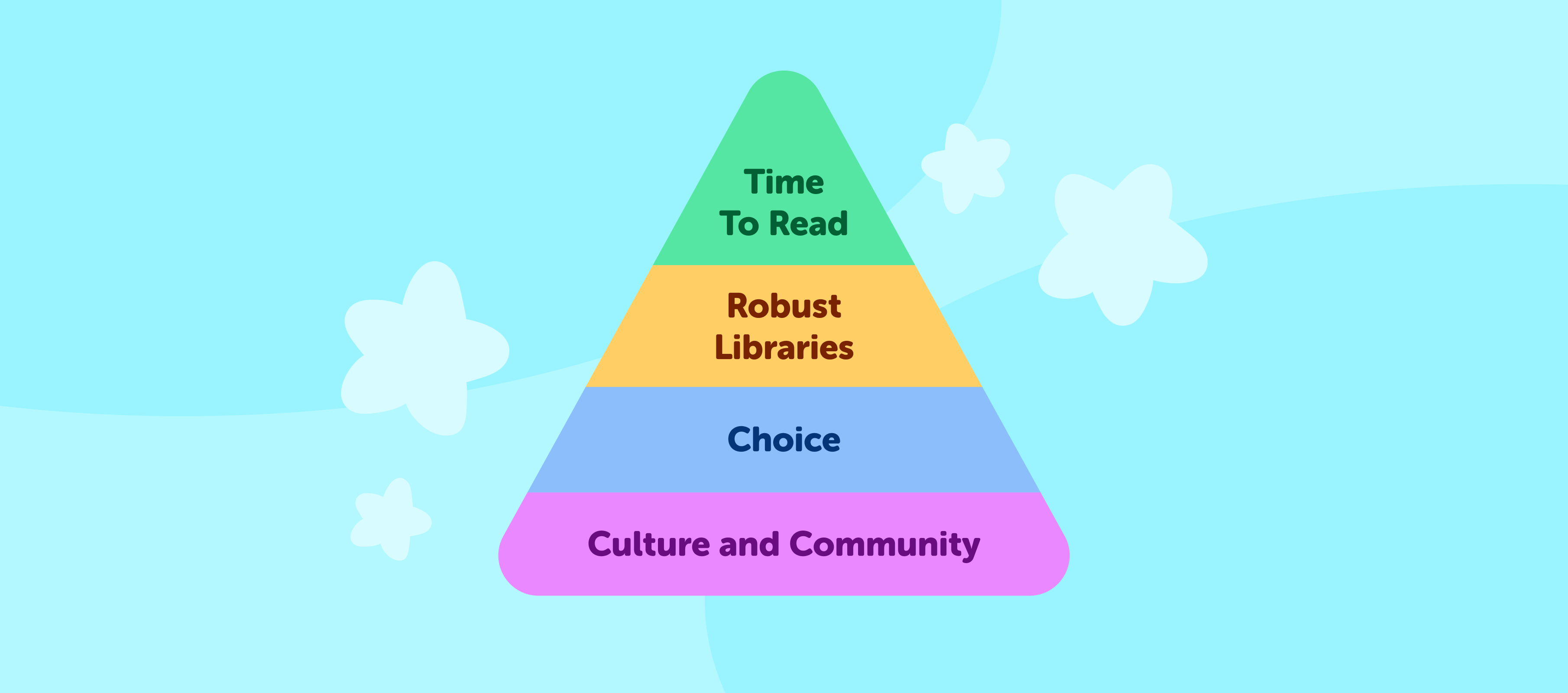
1. Culture and Community: Where Motivation Begins
Before reading becomes a habit, it has to become something that matters. Students don’t read simply because it’s good for them, they read because it has meaning in their environment. Cultures within communities create this meaning.
A strong reading culture is one where books are visible, shared, and talked about. It’s where reading is not just an academic task, but a social experience — something students see their peers and adults valuing. Research on motivation shows that social context plays a critical role in shaping behavior.
Here’s the reality: if reading has no cultural value, students will choose almost anything else. You can give them time, access, and choice, but without meaning, those efforts won’t stick. Culture is what turns reading into something students want to be part of.
2. Choice: The Driver of Engagement
Once reading has value, the next question is simple: what do students get to read? This is where choice becomes essential. A large body of research, including Self-Determination Theory, shows that autonomy is a key driver of motivation and persistence.
Students are no different from adults in this respect. When reading is entirely assigned, it can feel like compliance. When we give students the ability to choose, it becomes personal.
Choice also plays an important role in equity. Not every student connects with the same types of texts, and a limited set of options can unintentionally exclude many readers. When students have access to a wide range of materials and the freedom to explore them, they are far more likely to find something that resonates with them.
3. Access: Expanding What Counts as Reading
Choice only works if students have something meaningful to choose from. Access is the bridge between intention and engagement. Without it, even the most motivated reader can struggle to find the right entry point.
A robust reading environment includes a wide variety of formats, genres, and perspectives. It reflects the diversity of the students it serves and removes barriers like limited inventory or long wait times. This also includes expanding our definition of what counts as reading.
Research tells us that formats like graphic novels can play a powerful role in literacy development, particularly for reluctant readers. Organizations like the National Literacy Trust have found that comics and graphic texts can increase reading enjoyment and frequency. High-interest materials are not a distraction but rather the gateway.
Access, in this sense, is not just about availability. It’s about discovery and making it easy for students to find something they want to read.
4. Time: The Signal That Reading Matters
Even with culture, choice, and access in place, there is one more requirement: time. Reading takes time, and in many school environments, time is the most constrained resource. When schedules are full, independent reading is often the first thing schools reduce.
But time does more than enable reading; it signals value. When we carve out dedicated time for reading, we’re telling (and showing) students that it matters. Without that signal, even the best resources can go unused.
The relationship between time and achievement is straightforward. The more students read, the more they improve. This is one of the most consistent findings across literacy research, and yet it’s often the hardest piece to protect in practice.

From Behavior to Identity
When all four elements of the Reading Engagement Pyramid are in place, something powerful happens. Reading shifts from a task to a habit, and eventually to part of a student’s identity. That shift is where the real impact lies.
Students who see themselves as readers behave differently. They seek out books, make time to read, and continue to read beyond school.
That’s the outcome we’re working toward, not just better test scores, but lifelong readers.
At Joyful Reading Company, this is the work we’ve committed to. We believe that motivation and access are not separate challenges, but part of the same system. When they come together, they create the conditions for lasting change.
Through Beanstack, we help schools and libraries build motivation through community-driven reading experiences that celebrate progress. Through Comics Plus, we expand access to high-interest, always-available content that meets readers where they are.
Together, these tools support the full ecosystem outlined in the Reading Engagement Pyramid. But the larger goal goes beyond any single platform. It’s about helping communities build cultures where reading thrives.
A More Joyful Future for Reading
So how do we motivate kids to read?
Not through a single strategy, but by building environments where reading is valued, accessible, personal, and consistent. When those conditions are in place, reading stops feeling like work and starts feeling like something worth choosing.
It looks like a student staying up 10 minutes past bedtime to finish a book. A classroom buzzing with recommendations. A library filled with energy around a shared goal.
That’s the kind of reading culture we believe in, and it’s one worth building together.
Keep reading,
Felix Lloyd
CEO, Joyful Reading Company